Why the Jaguar E-Type Still Matters
More than sixty years on, the E-Type still stops conversations. A look at why the shape, the engineering and the myth have all lasted.
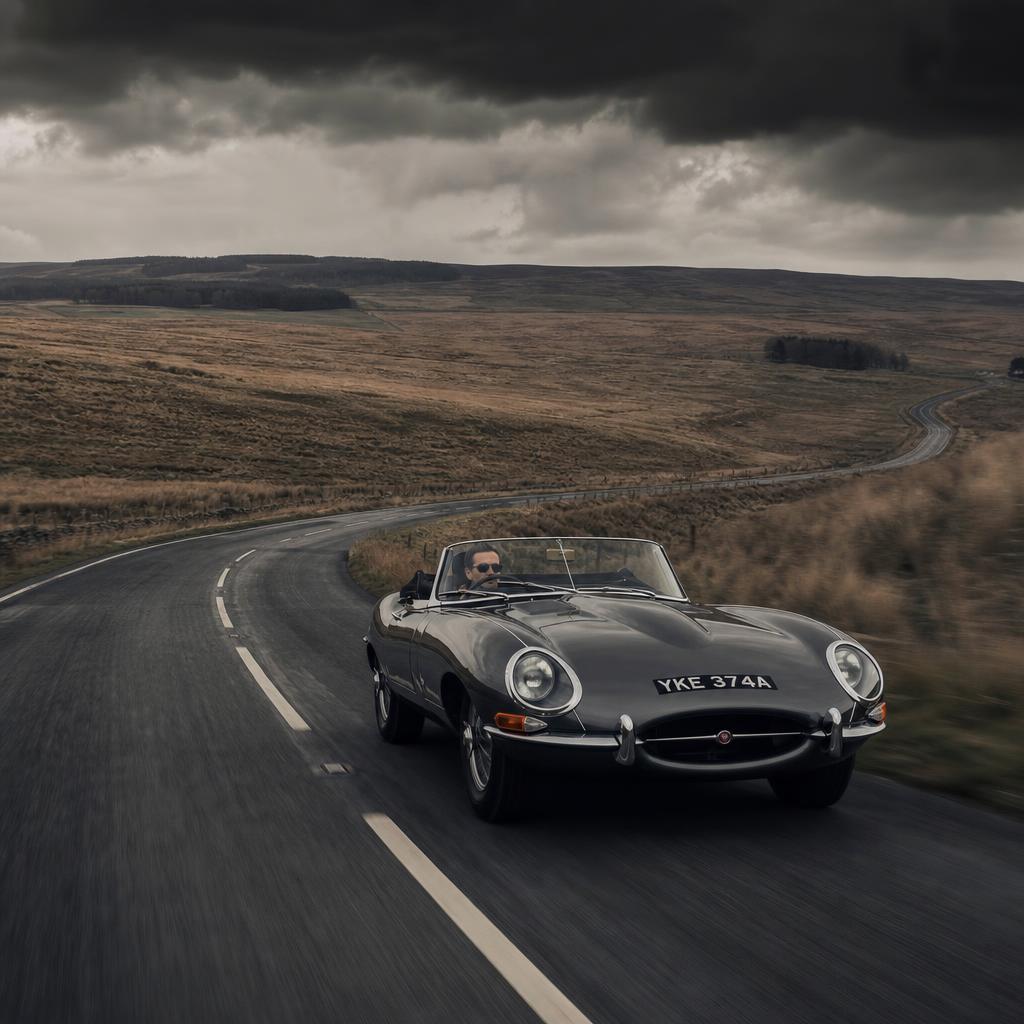
More than sixty years on, the E-Type still stops conversations.
Very few cars are genuinely famous. Most are known to people who care about cars and invisible to everyone else. The E-Type belongs to the small group that escaped the enthusiast world entirely: people who could not name a single other Jaguar know this shape.
It is worth asking why, because the answer is not simply that it is pretty.
Geneva, 1961
Jaguar launched the E-Type at the Geneva Motor Show in March 1961. The story goes that the reaction was such that a second car had to be driven overnight from Coventry to cope with the crowds.
What arrived was a car that made almost everything else on sale look immediately old-fashioned. It claimed 150 miles per hour at a time when that was close to unthinkable for a road car. It had four-wheel disc brakes and independent rear suspension when most rivals had neither. And it cost roughly half what an equivalent Ferrari did.
That last point matters more than the romance usually allows. The E-Type was not just beautiful. It was beautiful, faster than nearly everything, and comparatively attainable. That combination is what made it a phenomenon rather than merely an admired object.
The shape was engineering, not styling
The body was drawn by Malcolm Sayer, who came to Jaguar from the aircraft industry and worked as an aerodynamicist rather than a stylist. He designed using mathematics, and the E-Type's proportions descend directly from the Le Mans-winning D-Type before it.
This is why the car has aged so much better than its contemporaries. Its lines are not fashion. The long bonnet covers a straight-six that genuinely needed that much room; the tapering tail and low nose are there because Sayer was solving for air, not for the eye. Beauty was the by-product.
Enzo Ferrari is widely quoted as calling it the most beautiful car ever made. Nobody has ever pinned down when he said it, and it may well be apocryphal. It has survived for six decades because it sounds true.
Ours
Our car is a 1962 Series 1 roadster, finished in gunmetal grey over red leather. The Series 1 is the one to have: covered headlamps, small mouth, delicate chrome bumpers, none of the American regulatory compromises that thickened later cars.
The 3.8-litre XK straight-six under that bonnet is one of the great engines, and it does not sound like a modern car. There is induction noise, mechanical noise, and an exhaust note that hardens rather than gets louder as the revs climb. With the hood down there is no insulation between you and any of it.
It is also, and this is the part people do not expect, quite hard work. The steering is heavy at low speed. The gearchange wants deliberate movements. The brakes need a firm push. You drive an E-Type rather than operate one, and after an hour on a good road that turns out to be exactly the point.
Why it still matters
Because it was the moment a British company built something the whole world wanted, and did it with grace rather than force.
And because it still does the thing it was designed to do. Cars are objects of desire for perhaps five years, and then they become transport, and eventually they become old. The E-Type never made that journey. Pull up outside a church or a hotel in one and the reaction is the same as it was in Geneva: people stop, and they look, and somebody's grandfather tells you about the one he nearly bought in 1968.
Sixty-odd years is a long time for a shape to keep working. This one has not stopped.
Our 1962 E-Type Series 1 is available for weddings and for driving days. If you would like to arrive in it, see our wedding packages; if you would rather drive it yourself, the roads are ready.